


Imagine you’re about to sign a multi-step DeFi trade: bridging assets, swapping across an AMM, and giving an approval to a new router contract. You are in a rush because gas just dropped; you click through the popups and hit “Confirm.” A week later you find an approval drained your token balance. That scenario—speed over scrutiny—is the exact failure mode Rabby was designed to prevent. But installation and day-to-day use introduce subtler risks and trade-offs that power users sometimes under-appreciate. This article walks through how to install Rabby, what mechanism-level protections it offers, the common myths about “simulated security,” and the practical steps an experienced DeFi user should take to keep custody safe across 90+ EVM chains.
Installation is straightforward: the wallet runs as a Chromium extension (Chrome, Brave, Edge), a desktop client (Windows, macOS), and mobile apps (iOS, Android). That ubiquity matters because many attacks exploit context switching—using the wrong browser profile, misconfigured networks, or outdated clients. I’ll explain the steps that matter most to DeFi power users and then unpick the myths that flow from seeing a simulation screen and assuming invulnerability.
Step-by-step install and secure setup for power users
Install the browser extension or desktop client from a trusted source and pin it to your browser. For the extension, confirm the publisher and checksum if available; for desktop, prefer the officially signed installer. After installation, create a new non-custodial wallet or import an existing one via seed phrase only if you are certain the environment is clean (temporary offline machine or verified hardware wallet). If you use a hardware device, integrate it immediately—Rabby supports Ledger, Trezor, Keystone, CoolWallet, GridPlus, and BitBox02—so the private key never leaves the safe device. For many power users the best default is: extension + hardware wallet + separate browser profile for DeFi work.
Configure these practical settings early: enable automatic network switching so Rabby follows dApps to the correct EVM chain; enable the built-in pre-transaction risk scanning and simulation features; and add multi-sig or institutional integrations where relevant (Gnosis Safe, Fireblocks, Amber, Cobo) for shared custody. Finally, use Rabby’s approval revocation tool to remove lingering allowances—this simple habit mitigates the most common cause of post-exploit drains.
What Rabby actually protects against — and what it doesn’t
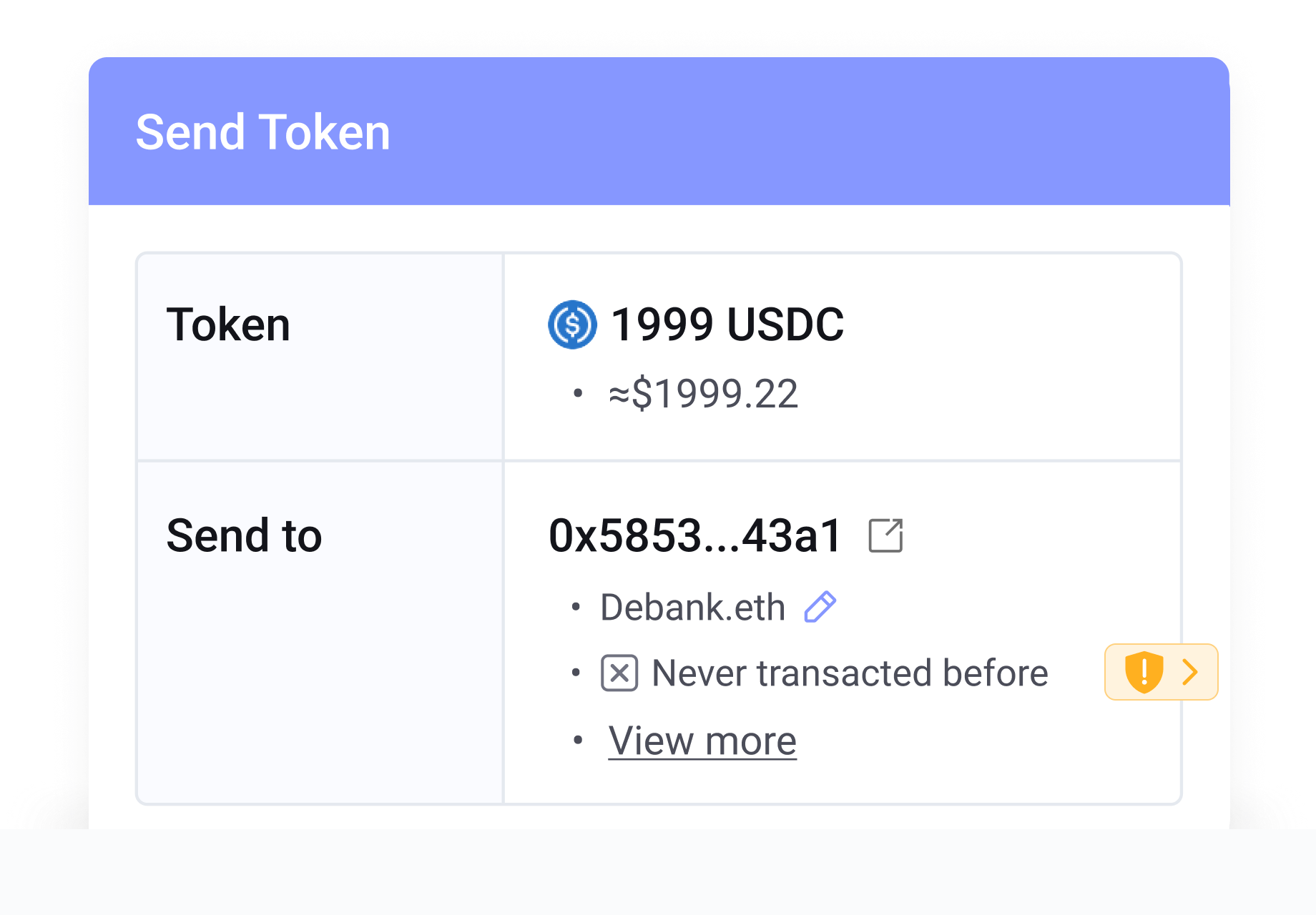
There are three distinct layers in Rabby that matter to decision-making. First, transaction simulation: before signing, the wallet runs the proposed call through a local or remote simulator and displays estimated token balance changes and fee costs. Mechanistically, simulation reveals what the transaction would do to your balances, which prevents blind signing of multi-call transactions that bundle unauthorized approvals or drains.
Second, pre-transaction risk scanning: Rabby checks recipient addresses, flags contracts with a history of hacks, and highlights suspicious approval patterns. That’s a signal-level defense—helpful for fast triage but not infallible. Detection depends on upstream threat intelligence and maintained blacklists; novel or deliberately obfuscated scams can slip through.
Third, hardware and institutional integrations: because Rabby supports a wide range of devices and multi-sig systems, it reduces exposure by keeping private keys offline or requiring multiple signatures. For power users managing large balances or treasury funds, this is often the single most effective control.
Myth: “Simulation equals safety—if the screen looks normal I’m safe”
Reality: simulation significantly reduces one class of error (blind signing) but it is not a panacea. Simulators show what a transaction would do given the current state of the chain and the contract code path exposed by the proposed call. They cannot foresee off-chain triggers, social-engineering that causes you to run malicious code, or future reentrancy from a separated call sequence. Simulations also often assume the contract behaves deterministically; malicious contracts can be deliberately complicated to deceive static analysis. So treat simulation as a powerful detective, not an impenetrable shield.
Myth: “Automatic network switching removes all human error”
Reality: automatic network switching reduces friction and fewer manual network changes means fewer accidental signings on the wrong chain. But it can hide the fact that a dApp is trying to push you to a less familiar L2 or testnet with different token tickers, where mistaken approvals are more likely. Power users should keep a short checklist: confirm the active chain, verify token tickers and decimals, and double-check the recipient address or contract label when the dollar amounts look off.
Practical trade-offs and limitations you need to know
No wallet can deliver perfect convenience and perfect security simultaneously. Rabby’s open-source MIT license and audit-friendly architecture increase transparency, but open source is not the same as audited and continuously monitored—it’s a platform for audits, not a guarantee. Its past incident (a 2022 Rabby Swap exploit that cost around $190,000) is a sober reminder: even teams that respond quickly can face losses. The team froze contracts and provided remediation, which demonstrates mature incident response, but the exploit itself underscores that integration complexity (e.g., in-wallet swap features) introduces additional attack surface.
Also note two concrete functional limitations: no built-in fiat on-ramp and no native in-wallet staking. For U.S.-based users that matters operationally: on-ramps imply KYC flows and regulatory surfaces; their absence means you’ll use centralized exchanges or third-party providers, introducing custody handoffs. Similarly, if you require native staking dashboards or direct validator interactions, you’ll need external interfaces or custodial services—Rabby aggregates DeFi positions but doesn’t remove the need for specialized staking tools.
Finally, cross-chain gas top-up is a practical convenience: if you bridge to a chain with zero native gas, Rabby can top up gas tokens for you. That convenience shifts risk only slightly: you still control which addresses receive token transfers, but the added cross-chain mechanics can complicate troubleshooting when something goes wrong.
Decision heuristics for different power-user profiles
Use these simple frameworks as reusable heuristics.
– Solo trader with frequent high-frequency trades: extension + hardware wallet + routine approval revocations; rely on simulation but keep small first-value interactions to test new contracts.
– Yield farmer or LP manager: integrate a multi-sig for treasury operations and use Rabby’s portfolio aggregation to detect position drift; avoid in-wallet swaps for large trades—use time-locked multi-sig or an off-chain settlement mechanism.
– Institutional custodian or team: favor Rabby combined with an enterprise signer (Fireblocks, Amber) and turn on all risk scanning. Require two-step confirmations for any new contract approvals and treat simulation screens as evidence in your internal audit trail, not as the final authority.
What to watch next — signals that would change how you use Rabby
Monitor three signals. First, improvements to simulation fidelity: if Rabby adds more dynamic analysis or real-time on-chain behavioral heuristics, your trust threshold for single-click approvals can be adjusted downward. Second, widening hardware and multi-sig integrations—if more custody providers plug in, Rabby becomes more attractive for institutional workflows. Third, any expansion into fiat on-ramps or staking would materially change user workflows and regulatory exposure; such moves should be evaluated carefully if you care about KYC boundaries or tax/reporting consequences in the U.S.
FAQ
Do I need a hardware wallet to use Rabby safely?
No, you can use Rabby as a purely software wallet, but for significant balances or frequent high-value DeFi operations a hardware wallet drastically reduces key-exposure risk because private keys never leave the device. Rabby’s hardware support is broad, so integrating one is straightforward and is a recommended best practice for power users.
Can Rabby’s transaction simulation prevent all scams?
No. Simulation prevents many blind-signing mistakes by showing estimated balance changes and fees, but it relies on the current chain state and known contract behavior. Sophisticated or novel scams, off-chain manipulations, and deliberately obfuscated contract logic can still succeed. Use simulation alongside other controls: hardware wallets, approval revocation, and conservative operational procedures.
How does Rabby compare to MetaMask for power users?
Rabby differentiates itself with explicit transaction simulation, pre-transaction risk scanning, automatic network switching, and broader built-in tools like approval revocation and cross-chain gas top-up. MetaMask remains ubiquitous and widely integrated; Rabby trades some of MetaMask’s ubiquity for focused security ergonomics. For power users who prioritize simulated visibility and approval management, Rabby is often the better operational fit.
Where can I install Rabby right now?
You can find the browser extension and platform-specific installers through verified distribution channels; for a quick start with the browser client, consider the rabby wallet extension page which aggregates launcher options. Always verify signatures and publisher details before installing.
Takeaway: Rabby raises the bar on a specific set of risks—blind signing, forgotten approvals, and accidental network errors—by combining transaction simulation, risk scanning, hardware compatibility, and multi-chain aggregation. But no single feature eliminates operational risk. The most reliable security posture for a DeFi power user remains compositional: hardware keys, disciplined approval hygiene, multi-sig for sizable funds, and using simulation as a diagnostic tool rather than a substitute for judgment. That mental model will serve you better than any single product claim.